

What are peptides, and how do they work at a molecular level? Why have they become so important in scientific research and analysis?
In this article, we will answer these questions and more by providing a clear and structured overview of peptides, explaining what they are and how they work from a scientific perspective.
You will also get a better understanding of where to buy reliable, high-quality peptides online.
What Are Peptides?
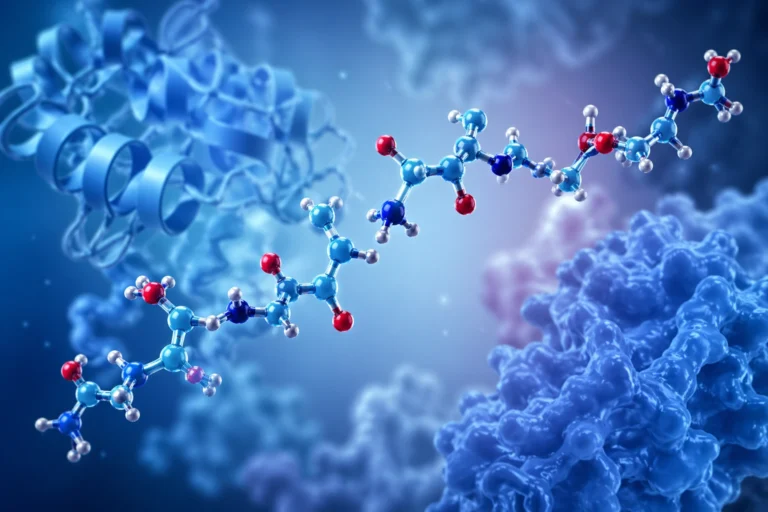
Peptides are short chains of amino acids linked together in a specific order.
Amino acids are the building blocks of larger biological structures. When two or more amino acids connect through chemical bonds, they form a peptide.
These chains are smaller than proteins but share the same fundamental structure.
The main difference lies in the size. Peptides are shorter, while proteins are longer and more complex.
You can think of it like this:
- Amino acids = individual building blocks
- Peptides = small chains made from those blocks
- Proteins = larger, more complex structures
The exact sequence of amino acids in a peptide determines its properties and how it behaves in different environments.
Peptides Explained in Simple Terms
To make things easier to understand, you can think of peptides as small chains of building blocks that are designed to interact in specific ways.
Each of these building blocks, called amino acids, has its own unique properties. When they are arranged in a particular sequence, they form a peptide with its own structure and behavior.
Even a small change in this sequence can affect how the peptide functions, which is why structure matters so much in research.
In simple terms, peptides are short chains of amino acids linked together, smaller than proteins but built from the same components.
How Do Peptides Work?
To understand how peptides work, you need to know more about their structure.
Each peptide has:
- A defined sequence of amino acids
- A specific shape or arrangement
- Chemical properties based on that structure
These features influence how the peptide interacts with its surroundings.
In research environments, peptides are studied because they can interact with other molecules in controlled ways.
Their structure allows them to bind, signal, or participate in biochemical processes at a molecular level.
For example, some peptides are studied for how they interact with proteins, whereas others are used to observe molecular pathways or are designed to mimic naturally occurring compounds
Their function depends entirely on their sequence and structure.
The Science Behind Peptides
The science behind peptides is rooted in chemistry and molecular biology.
Peptides are formed through peptide bonds, which link amino acids together in a chain.
The order of these amino acids, known as the primary structure, plays an important role in determining how the peptide behaves.
Beyond this, peptides can adopt different shapes depending on their environment.
Moreover, because peptides sit between small molecules and large proteins, they are often described as bridging the gap between the two. This is also why they are so useful for studying detailed molecular interactions.
Why Peptides Are Studied in Research
Thanks to their versatility and precision, peptides are widely studied in research environments.
Researchers use them to examine a wide range of activities, such as:
- How peptides interact with cellular processes
- How they behave under different conditions
- How their structure influences their function
For example, BPC-157 is used in lab settings for its potential in cellular repair and recovery studies, whereas MOTS-C is studied for its role in cellular energy, metabolic function, and overall mitochondrial activity.
These observations contribute to a broader understanding of biological mechanisms.
But why are they considered to be so valuable within the research context?
These are a few key reasons:
1. Controlled Structure
Peptides can be designed with specific sequences that allow researchers to study targeted interactions.
2. Reproducibility
Their defined composition makes them easier to reproduce under controlled conditions.
3. Analytical Clarity
Peptides can be analyzed using established techniques to understand their composition and behavior.
4. Flexibility in Research
They can be used to explore a wide range of biochemical processes.
5. Simplicity and Functionality
Peptides are small enough to be studied in detail, structured enough to perform specific interactions, and flexible enough to be used across different research areas.
Overall, the benefits of peptides for research are due to their precise structure and adaptability, which support ideal study conditions.
How Peptides Are Analyzed
Researchers use analytical techniques to examine the structure and composition of peptides.
One widely used method is High-Performance Liquid Chromatography (HPLC).
HPLC works by separating the components of a sample so they can be analyzed individually.
This helps determine how much of the sample corresponds to the intended peptide and how much consists of other components.
In peptide analysis:
- The sample is passed through a column
- Different components separate based on their properties
- Results appear as peaks on a chromatogram
This type of analysis provides measurable data that supports research evaluation.
Conclusion
So, what are peptides? In simple terms, they are short chains of amino acids that can be studied to better understand molecular interactions.
And how do peptides work? Their function is determined by their structure and, more specifically, the sequence and arrangement of amino acids that define how they behave in different environments.
The science behind peptides remains an important area of study, particularly in controlled research settings where precision and consistency are so crucial.
Looking to buy peptides online in the USA from a company that prioritizes quality standards? Make sure to check out our current products.
We, at Pure Aminos, prioritize quality, consistency, and transparency. All of our compounds are produced using controlled synthesis methods to support reliable research findings, with a focus on consistent production, secure packaging, clear labeling, and proper research documentation.
If you have any questions, concerns, or requests, please feel free to reach out. You can give us a call or drop a text at 765-823-9032. Our team is always happy to help!
Disclaimer: Our products are strictly intended for research purposes only and not for human consumption.